Vulnerability disclosure policy for plugin vendors (CRA)
How to write a vulnerability disclosure policy for paid WordPress plugins: scope, safe harbor, realistic targets, CVSS triage and when CRA reporting starts.
Also in: Deutsch Français Español Italiano Polski Português Türkçe

If you sell a WordPress plugin or theme, sooner or later someone will find a security hole in it. A vulnerability disclosure policy decides what happens next: either the researcher writes to you and you fix it quietly, or the first you hear of it is a public advisory. This guide gives small vendor teams, often one to five people, a working policy structure, example wording and the internal routine behind it. It also shows the one point where an ordinary bug report becomes a legal reporting duty.
Why plugin vendors need a vulnerability disclosure policy now
The Cyber Resilience Act (Regulation (EU) 2024/2847) requires manufacturers of products with digital elements to have a vulnerability handling process and a coordinated disclosure policy. These main obligations apply from 11 December 2027. One part is already in force: since 11 September 2026, manufacturers must report actively exploited vulnerabilities and severe incidents affecting their products.
This applies to you if you sell a paid or otherwise monetised plugin or theme to EU customers. In that case you are the manufacturer. Free, non-monetised open-source plugins are generally outside the manufacturer regime. Our CRA overview for plugin sellers covers scope, timeline and fines in full.
The reports will come. Patchstack, a security vendor, counted 11,334 new vulnerabilities in the WordPress ecosystem in 2025. Of these, 91 % were in plugins, and 46 % had no fix available from the developer when they were publicly disclosed (Patchstack, State of WordPress Security in 2026). A fix can only be ready at disclosure if the vendor heard about the bug in time and acted on it. A published policy with a monitored channel gives researchers a reason to come to you first.
What the policy must say: scope, reporting channel, safe harbor wording
Keep the policy to one page. Researchers skim it to find three things: whether your product is covered, where to send the report, and whether they will get into trouble. Write it in that order.
Scope. Name the products and versions you support, and say what is out of scope.
How to report. Give one address and list what you need: product name, exact version, WordPress and PHP version, steps to reproduce, a proof of concept, and the impact as the researcher sees it. Ask them not to include real customer data.
Good-faith wording. Say that you will not take legal action against people who act in good faith within the policy. That means testing only on their own installations, not accessing other people's data and giving you reasonable time before publishing. Do not promise legal immunity. You cannot waive other parties' rights or criminal law, so don't suggest you can.
Coordination. Explain how you agree a publication date. For example: "We will agree a disclosure date with you. By default we aim to publish an advisory together with the fix, and we ask you to wait until a fixed version is available or 90 days have passed, whichever comes first." The 90 days is a common convention, not a legal rule. Pick a number you can keep.
Credit and bounties. Say whether you credit reporters in the advisory and changelog, and whether you pay. "We do not run a paid bug bounty, but we credit every valid report" is an honest and acceptable answer.
Response and fix targets you can actually meet
Researchers want to know when they will hear back. Give them targets, and label them as yours. The CRA does not set any deadline for answering a researcher. Its deadlines apply to reports to the authorities about actively exploited vulnerabilities and severe incidents.
This is an example for a small team. It is not a requirement.
| Step | Example target (self-chosen) |
|---|---|
| Acknowledge receipt | 3 business days |
| Triage decision | 10 business days |
| Fix, critical/high | 30 days |
| Fix, medium/low | Next regular release |
Set the targets for your worst week, when someone is ill or on holiday, not your best. If you miss one, send a status update with a new date. A researcher who gets a short "still working on it, expect a release by the 20th" rarely publishes early. A researcher who gets silence often does.
The intake channel: security.txt, a dedicated address and who reads it
Use a dedicated address such as security@yourdomain.eu. It should land in a shared mailbox or ticket queue that at least two people read, not in the founder's personal inbox. Write down who covers holidays. If you offer an encryption key, someone must be able to decrypt reports when the key holder is away.
Link the policy from the Policy field of your security.txt, from each product page and from the plugin readme. Our security.txt guide covers how to publish and test the file.
Reports also arrive by other routes: support tickets, vulnerability databases and platforms that contact vendors for researchers, or a comment on your support forum. Point all of these to the same queue. Brief your support staff so that anything mentioning "XSS", "SQL injection" or "unauthenticated" is forwarded the same day.
Internal triage: reproduce, rate with CVSS, decide
Use the same routine for every report so that nothing depends on who happens to read it.
- Log the report with a case ID and send the acknowledgement.
- Reproduce it on a clean test install with the reported version. Never test on a customer site.
- Rate it with a CVSS base score. Note the attack preconditions: unauthenticated, any logged-in subscriber, or administrator only. They change the real risk more than any other factor.
- Check every affected version, including older branches you still support.
- Find the root cause, then search the codebase for the same pattern. One missing capability check usually has siblings.
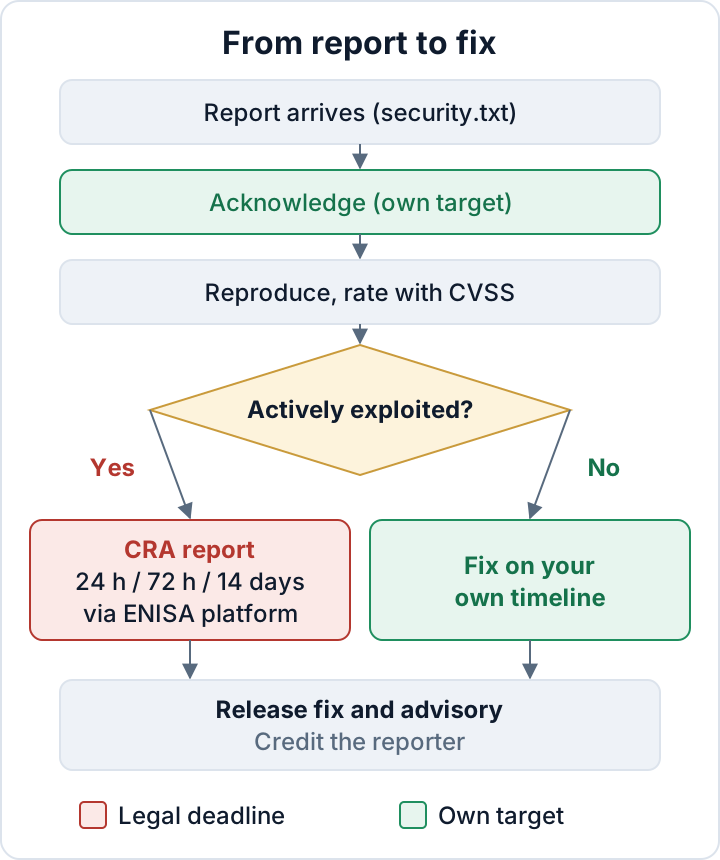
- Ask one more question: is there any sign this is already being exploited? This decides the next section.
- Build the fix and release it. The changelog should clearly say "Security fix", with the affected versions.
- Write the advisory, agree the date with the reporter and credit them.
- Close the case with a record: dates, decisions, versions, advisory link. Under the CRA, this record is your evidence of a working process.
Broken access control is the most exploited category in Patchstack's data. Our access control guide for plugin developers covers the code-level fixes. Before a release, an automated taint analysis of your plugin code, such as the one in the Security Audit & Compliance plugin, can catch some unsafe data flows early. It does not replace a manual review.
When a report becomes a CRA notification
The decision point is narrow. A vulnerability that is reported to you but not exploited does not trigger the CRA reporting duty on its own. There is no 24-hour clock: you fix it through your normal handling process, using your own targets, and still without unnecessary delay.
Evidence of active exploitation changes that. Evidence can be attack traffic described by a customer, a host or a researcher, or a compromised site traced to your code. Once you know a vulnerability in your product is actively exploited, the manufacturer duty applies:
- early warning within 24 hours
- notification within 72 hours
- final report within 14 days after a corrective measure is available
Severe incidents affecting your product follow the same 24 h and 72 h steps, with a final report within one month. Reports go through ENISA's CRA Single Reporting Platform to the CSIRT of the Member State where your main establishment is, and ENISA receives them at the same time (European Commission: CRA reporting).
Twenty-four hours is short, so prepare now. Decide who files the report and who is the backup. Keep a template with the details you will need: product, affected versions, nature of the exploitation, mitigations and fix status. Decide how you will tell customers, for example by email to licence holders or a notice in the dashboard. The details are in our CRA article.
Publish, test and review the policy
Publish the policy at a stable URL such as /security/ and keep it there. Link it from your website footer, security.txt and every product readme. Changing the URL breaks links in old advisories and directories.
Then test it. Ask a colleague or a friendly developer to send a harmless test report from an outside address. Check whether it reached the queue, whether the acknowledgement went out within your target, and whether the person on duty knew the next step. Fix whatever failed.
Review the policy once a year and after every real case. Keep it consistent with your stated support period and your update channel. A policy that covers "all versions" while you only patch the current one will cause trouble.
Your next step: draft the policy this week using the section list above: scope, how to report, good faith, coordination, credit, targets. Set up the shared security@ queue, then name the person who files a CRA report if something turns out to be exploited.
FAQ
Do free plugins on WordPress.org need a vulnerability disclosure policy?
Free, non-monetised open-source plugins are generally outside the CRA manufacturer regime. If the free plugin is part of a paid offering, for example the base of a freemium product, check your situation with our CRA article. A short policy and a working contact address are still good practice, because researchers will find bugs either way.
Do I have to pay bug bounties?
No. A bounty is optional. Say clearly in the policy whether you pay, and credit reporters either way.
Must I disclose vulnerabilities publicly?
Coordinated disclosure means a fix plus an advisory, so customers know to update. Agree the timing with the reporter. Customers cannot protect themselves from a hole they don't know about.
Is a CVSS score legally required?
No. CVSS is a tool that makes your severity ratings consistent and explainable. Any clear, documented rating method will work.
This article is general information, not legal advice.
Check your own site
Security Audit & Compliance is the WordPress plugin from secaudit.eu: it scans for malware, hidden spam, changed core files and vulnerable code, and maps its findings to GDPR Art. 32, NIS2 Art. 21 and the OWASP Top 10.
See what the plugin checks